/var/log/tuxtone · maintenance archaeology
What happened to NoiseTorch? A maintenance timeline
If you searched for Linux noise suppression any time in the last six years, NoiseTorch was the first thing you found. Ten thousand stars. A one-button interface people genuinely loved. It is still, today, the most-recommended answer on forums, in listicles, and in the helpful reply under someone's question — and the project has not shipped a release since June 2022.
That gap between reputation and repository is the most interesting thing in this niche, and it's worth walking through properly. Not to bury the project: NoiseTorch still works, and we keep a page on when to use it. But because the story is the clearest lesson available in what "maintained" means, how a community can rescue a codebase and still not rescue a project, and how to read these signals yourself.
2020–2022: the right answer
NoiseTorch did one thing with unusual clarity. It was a small Go application that wrapped RNNoise, and when you clicked Load NoiseTorch it created a virtual microphone your applications could select like any other device. No configuration files, no audio graph, no vocabulary to learn. On the PulseAudio desktops of that era it was simply the best available answer, arriving precisely when a pandemic moved everyone's calls into rooms with fans, families and mechanical keyboards in them.
Its release cadence through that period was healthy. Version 0.12.0 landed at the start of June 2022, and v0.12.2 followed on 17 June 2022 — a release whose notes cheerfully announce that the update mechanism was finally fixed for good, and that all future updates would arrive through the interface. It remains the most recent release, which gives that sentence a certain weight in hindsight.
2022: the scare
Later in 2022, the project reported a suspected compromise of its infrastructure — the update server and repository — and development as users had known it stopped. The original developer stepped back.
What happened next is the part worth remembering, because it is open source working exactly as advertised. Rather than the project simply evaporating, volunteers went through the source and the binaries looking for anything malicious. The conclusion, stated plainly in the project's own README today, is that no malicious code was found. The update mechanism was changed so that releases come from the project's releases page rather than from the compromised update infrastructure. The work continued under community stewardship, under the name NoiseTorch-ng, in a GitHub organisation rather than one person's account.
2022–2026: the quiet
Here's where a happy rescue story turns into a maintenance story. The audit succeeded. The continuation was real. And then the commits thinned out to almost nothing.
| Signal | What we found, 2026-09-20 |
|---|---|
| Latest release | v0.12.2 — 2022-06-17, over four years ago |
| Last commit, default branch | 2025-01-13 (a merged pull request closing a response body) |
| The commit before that | 2024-04-28 — the same fix, nine months earlier |
| Archived? | No. The repository is open and accepting issues |
| Open issues | 70 |
| Stars | Over 10,300 — the reputation is entirely intact |
| Arch official repos | Absent. AUR only |
| Debian | No package, in any suite |
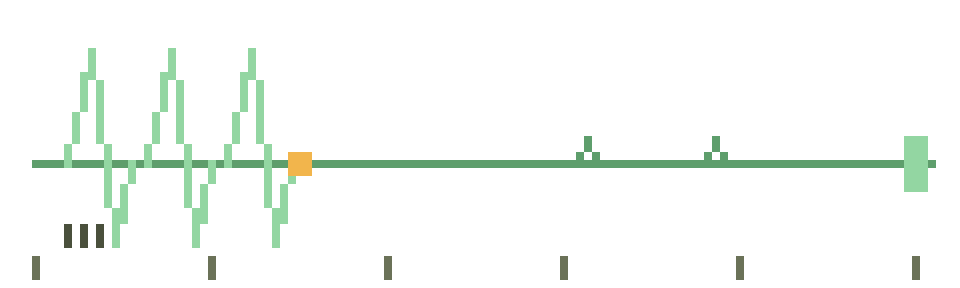
- 1v0.12.0 at the start of June, then v0.12.2 on the 17th — still the latest release
- Bthe scare, the audit, the NoiseTorch-ng continuation
- 2a commit: the response-body fix
- 3the same fix, merged again — the last commit
- 4checked: not archived, 70 open issues, over 10,300 stars
Two commits in roughly two years, both housekeeping. That's not abandonment in the dramatic sense — nobody archived anything, nobody posted a farewell — and that's exactly why it fools people. An unarchived repository with recent-ish activity looks alive at a glance. You have to look at the release history to see that nothing has shipped to users in four years.
The four checks, generalised
This is the transferable part. Before trusting any open-source tool with something that matters, we run the same four checks, and none of them take longer than a minute:
- Latest release, not latest commit. Releases are what users install. A repository can accumulate typo fixes and dependency bumps for years while shipping nothing.
- Commit history on the default branch. Not "is there activity" but "what kind, how often". Two housekeeping merges in two years is a different animal from a steady stream of fixes.
- Official distro packaging. Distribution maintainers are an unpaid early-warning system. When a package is AUR-only and absent from Debian, that is a considered judgement by people who package software for a living.
- Issue responsiveness. Seventy open issues with the recent ones unanswered tells you who the support team is: you.
Notice that none of these ask how the software sounds. NoiseTorch's audio is fine — it's RNNoise, the same model that EasyEffects and the filter-chain run. You are not choosing between audio qualities. You're choosing between a tool someone is tending and a tool frozen in 2022, on a desktop stack that has moved through years of PipeWire releases since.
What would change our verdict
One tagged release. That's the whole list. In our scoring script, a fresh release resets NoiseTorch's maintenance component from 3 points to 30 and moves it from 49/100 to 76/100 — past the filter-chain and into genuine contention, because every other thing it does well, it still does well. The repository isn't archived. The one-button experience remains the friendliest anyone has built for this job. We would update this post cheerfully.
Until then, the honest summary is the one we put on its page: dormant, still usable, mostly replaceable. And if you take nothing else from this timeline, take the habit — check the releases page before you trust the star count.